Tuesday, October 11, 2022

The Dream Of A Journalist

My name is Mulenga Chanda. I was born in Nkana East, Kitwe, in the 1970s and I am a journalist. A freelancer. As a child, I wanted to be a lot of things and a journalist wasn’t one of them. My parents made sure that my brothers and I went to the best schools and provided us with everything a child would need and want. In retrospect, my parents’ success was my curse. As a partaker of my parents’ wealth, why did they want me to get educated? Don't people go to school to amass wealth in future? Now why should those who are already rich get educated? But little did I know that wisdom and knowledge cannot be inherited. I was only a child sowing, and now 30 years later, I'm reaping. The law of seedtime and harvest is cruel. Very cruel indeed. Well, as expected I failed to make it into grade eight, but father's influence secured me a place at one of the high-end secondary school. This secondary school was where the crème de la crème, the best of the best minds went for secondary education. Another group of children found there was of those with parents who could afford the school’s invoice.

I was chased from there, for what the authorities called ‘bad behavior’. I was caught smoking. Is smoking that that bad to deserve a dismissal from school? And no, it wasn’t nicotine. In my effort to be absolved, I told them it was for medical reasons. It was a shot in the dark.

Nonetheless, I finished school through push and pull and hey presto I even managed to do journalism at some of those colleges, where today it’s a college and tomorrow it’s a house. My college was even without any proper mailing address. It was care of some individual, The Principal. His name is on the tip of my tongue, maybe I will remember it later.

I did journalism because I wanted to be famous. Journalists are famous right? They are always in the media with their stories, especially political scandals. Those journalists are famous. Everyone knows them. I wanted to be famous. I was going to be this journalist, I decided.

I would relentlessly narrate to my girlfriend how proud and eventually famous she will be when her man becomes one of the most famous journalists. And she entertained my hallucinations. I bet that is what lovers do, cheering on their partners to dream.

That was a long time ago. I am now thirty. I am now a journalist. But not what I imagined I will be. No. the prefix freelance was what I was using to hide the fact that I was a latent failure and bad with the job. Media houses also exploited me every time I was selling a story to them. Damn capitalists. I had no choice but to accept that exploitation was part of my condition of service. At least the peanuts they were giving me could pay my two roomed servants quarter I was renting in Kalingalinga and buy me the necessities I need to survive the hustles and bustles of the Lusaka life.

It’s true, life is a grindstone, and it was grinding me down.

Since I could not afford to drink from expensive places, I patronize cheap and stinky drinking spots. My favorite was one place called Die Hard Tavern in Kalingalinga. Its owner must have been a Bruce Willis fan. This place’s smell was a mixture of Chibuku, sweat, urine and some smells that one cannot really put a finger on. Patrons could just urinate from the tavern’s wall.

I bought and got drunk on Chibuku. Just added some milk, and it went down well. On my way home, I would buy one bottle of Mosi or Castle lagers to show off to my landlord that I was doing well in my job. Even a struggling man must have some self respect. Very important!

I haven’t had any story to sell to these media capitalists for two weeks now. Am I losing my touch? How am I going to pay my house rentals? It was 08:00hrs on the clock but I was already at the watering hole galloping from the Chibuku that I bought. Then I remembered that I had a K1 coin in my pocket, allowed my hand to dive in there and fish it out.  I then walked to the Juke Box, throw in the coin and pressed the number for House of The Rising Sun by The Animals. As I walked back, I overheard one of the bar patrons telling a friend that a burglar was shot at his neighbor’s house in the wee hours as he tried to enter through the window.

I got interested, dragged my chair there and listened to this man, who we all called Long Spanner, narrating the story. Long Spanner is obviously a tall glass of water and walks like he has all the problems of the world on his shoulders. Whenever he is just standing, he looks like a tree resisting being blown over by a wind gust. He is the best motor vehicle mechanic in the neighborhood, though. Grapevine has it that he always has a spanner in his deep pockets. What a guy!

I got my note book and wrote down some few information from this story. I learnt that the man who got shot was currently admitted at Levy Mwanawasa General Hospital.

This was my break.

Before Long Spanner could even finish his story, I absquatulated and decided to go straight to Mwanawasa General Hospital to look for this story. I took out my cellphone and called Peter, a taxi driver. Peter is a highly skilled driver; someone you need to call if you want to be early for a meeting starting at 11:00hrs even when its already quarter past that time. In life, always contacts for people that are best in their respective fields.

Now, I helped Peter find his job and hence he felt indebted to me and he had himself the responsibility of driving me home from drinking spree whenever needed.

When he arrived for my pickup, he was with a female passenger.

‘Boss this passenger is going to Chelstone,’ shouted Peter as he winked at me whatever he meant this time around because in behaviour, Peter is more slippery than an eel.

Throughout the shot trip to Levy, I kept on thinking how this would be my breakthrough story. My rentals cheque. I wanted to be the one capture. I wanted it so bad. And wanted to the first journalist. You know, journalism is a cutthroat job, you need to be the first one to report a story if you want to reap the full rewards. The whole universe has just conspired to help me. 

At Levy, I hatched a plan on how to avoid the Police and the medical staff and get hold of the burglar. Get the story from the Balaam donkey's month. I was meticulous in my scheme. I need to look for a white lab coat and pretend that I am one of the medical team...............

Suddenly, I started hearing a familiar sound. It was the alarm. It woke me up with the sound of my favorite music. 

Phew, what a dream that was?  I have never even tasted alcohol in my entire life. Maybe I need a totem to test my own reality. 

"What is real. How do you define real? If you're talking about what you can feel, what you can smell, what you can taste and see, then real is simply electrical signals interpreted by your brain." - Morpheus (The Matrix)

Wednesday, October 5, 2022

Happy Bilated Birthday Nigeria

On 1st October 1960, #Nigeria got independent. However, this would be the beginning of an arousing pleasure marinated in sadness and pain. Between 1960 and now, the country would see 5 successful military coups and 3 which got foiled. In fact there was uninterrupted military leadership from 1966 to 1999 save a brief democratic dispersion from 1979 to 1983.

23 years later in 1983, the erudite writer Chinua Achebe would publish a damning evaluation of his country in The Trouble With Nigeria as lack of patriotism, social injustice, tribalism, indiscipline, social injustice, culture of mediocrity and corruption. How much has changed since then?

"The trouble with Nigeria is simply and squarely a failure of leadership. There is nothing wrong with the Nigerian land or climate or water or air or anything else. The Nigerian problem is the unwillingness or inability of its leaders to rise to the responsibility, to the challenge of personal example which are the hallmarks of true leadership." 

This is the opening paragraph to the book. You can remove Nigeria and replace it with any of the 49 Sub-Saharan African countries, and this statement will still hold. Later, renowned leadership expert, John C. Maxwell, would aptly agree with him when he opined that “everything rises and falls on leadership.” 

We are on Nigerian. 

Even now, the country is grappling with lack of job opportunities which is causing high poverty levels, regional inequality, and social and political unrest. Sprinkle in the security challenges due to the emergence of Boko Haram

Africa's most populous country must exorcise itself from ghosts of challenges past and rise above them like it's national Eagle. Arise, O Compatriots! The starting point is to have free and fair elections in February 2023 and resist the temptations of electoral violence. Current leaders and aspirants must set this tone by giving the  Independent National Electoral Commission the necessary political support.

#NigeriaAt62

Sunday, October 2, 2022

AFTER TWO DECADES OF ECONOMIC SANCTIONS ON ZIMBABWE, ARE THEY JUSTIFIABLE?

Zimbabwe is 42 years old and almost half of that has been lived under economic sanctions. It was refreshing, thus, when African leaders used the United Nations General Assembly (UNGA) some few days ago to push for an end to more than 20-year western sanctions on Zimbabwe, arguing that the sanctions are damaging to ordinary people and the region. Senegalese President Macky Sall, the head of the African Union (AU), called for the "immediate lifting of sanctions to allow Zimbabwe to realize its full potential". The President of the Democratic Republic of the Congo, Felix Tshisekedi, who’s also the current leader of the Southern African Development Community (SADC), described the sanctions against Zimbabwe as "a crime against an innocent people.'

According to Kenyan President William Ruto, "the one-sided coercive measures such as those imposed on Zimbabwe not only punish the sovereign equality of nations, but also indiscriminately punish the general citizenry and retain their bitterest sting for innocent hustlers and the weak." South Africa's President Cyril Ramaphosa demanded (speaking through Foreign Minister Naledi Pandor) "an end to unilateral coercive measures against Zimbabwe which have exacerbated the problems of the Zimbabwean people". Ramaphosa would also in a meeting with US President Joe Biden ask for the lifting of sanctions in Zimbabwe.

These African leaders are on terra firma and I elect to stand with them. A father that stops buying food because he has a bone to chew with his wife isn’t punishing the wife, but mainly the children. Besides chewing bones can be dangerous, no matter what size or what type. Like the famous African proverb, "when elephants fight, it’s the grass that suffers". A miscalculation in the game theory and underplaying the butterfly effect.

Background

After the signing of the Lancaster House Agreement on 21 December 1979, brining to an end of the Second Chimurenga also called the Zimbabwe War of Independence and to the internationally recognition of Zimbabwe from Rhodesia. This also meant the full resumption of direct British rule and the reversal of the 1965 Unilateral Declaration of Independence (UDI). Independence would be granted on 18 April 1980 with Robert Mugabe becoming the first indigenous Prime Minister.

In the very same 1980, the infamous – or famous depending on which side of the fence you are on – Land Reforms would start with partial funding from the United Kingdom which saw the resettling of around 70,000 black people initially without land on 4,900,000 acres in the new independent Zimbabwe. This was a drop in the proverbial ocean. The US and UK had offered to compensate white citizens for any land sold to aid reconciliation using the "Willing buyer, Willing seller" principle which is a market driven land reform with much support from landowners. However, this failed to right the wrongs made by the historical expropriation and high poverty. In the late 1990s, the then President Robert Mugabe declared the compulsory acquisition of land. Land acquisitions would turn violent in the early 2000s with 7 white farmers being killed and “much larger number of black victims” working on those farmers. This was the watershed moment.

The Zimbabwean economy would suffer a great hit which people like Craig J. Richardson attributing it to the land reforms. The EU, UK, Canada, Australia, New Zealand and the US would also place sanctions on Zimbabwe because of ‘the land reforms and the human rights abuses’. Its more than 2 decades now and the leadership in Harare has changed but nothing much has changed on the sanctions despite the standing ovations given to the ousting of Mugabe as president.

Now, dear reader, I’m not Zimbabwean. I have never been to Zimbabwe. I’m not a historian. I'm just a keen student of life and life has many lessons for all of us. I’m just here to critique sanctions as a human rights abuse. I will highlight why I feel that they create the very problem that it envisages to solved. As you read, dear reader, you must also not forget that the objective of the Chimurenga fighters was to reclaim their lands by challenging the IDU and colonialism while also achieving democratic autonomy.

Do Sanctions Work?

States, its agencies and agents including independent great minds have always claimed that the most effective way of bringing a wayward country back into line is by placing economic sanctions on it. The war without guns. Economic sanctions are coordinated restrictions on trade and financial transactions intended to impair economic life within a given territory. Since the end of the cold war, they have been more prevalent.

However, the ethical, political and moral justifications for such measures are seldom interrogated. In Economic Sanctions Reconsidered, Gary Clyde Hufbauer, Jeffrey J. Schott, Kimberly Ann Elliott and Barbara Oegg of Peterson Institute for International Economics (PIIE) studied more than 200 economic sanction cases and concluded that only succeeded in 1/3 of all cases. In 2/3 of application, the sanctions had failed to achieve the intended objective. Below I explain the consequences on sanctions on healthcare, education, human rights, and ethics on the recipient country. What history will be written as an outcome of these sanction?

Sanctions Negatively Affects the Healthcare System

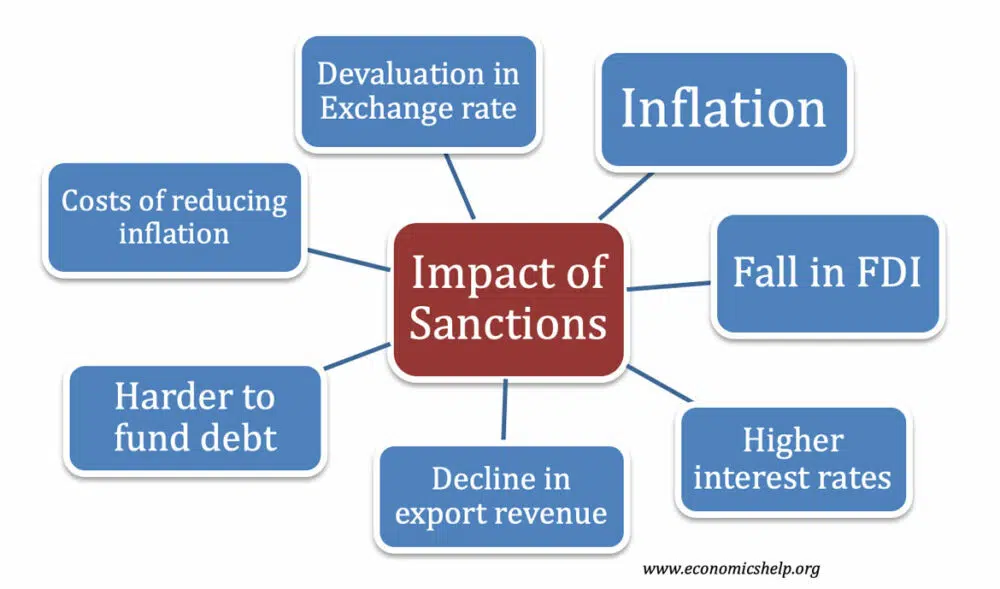
Sanctions may not formally ban the exports of medicines; in practice, however, patients are experiencing great difficulty in securing the treatment. This significantly cripple the public healthcare system. And this negates all the progress that had been made in improving quality, leading to a huge economic and social costs which may include disability and lost productivity, and generally low quality of life in the population. All the progress 1980s was severely disrupted and saw the period from the 2000s resulted in a sharp and prolonged decline in health expenditure and increasing health inequalities. For example, neonatal complications, protein energy malnutrition and lower respiratory infections caused 24.64%, 1.85% and 10.27%, respectively, of under 5 deaths in 1999 before sanctions kicked in. 20 years later in 2019, there was an increase to 36.52%, 6.77% and 19.48% in deaths caused by neonatal complications, protein energy malnutrition and lower respiratory infections respectively. Public healthcare across the country is currently grappling with a growing shortage of nurses driven by the search for private jobs and greener pasture, particularly in the UK.

However, when those in leadership get sick, they are flown out to South Africa, India or China to access proper and quality healthcare since the healthcare system back home is dead. They live and die in opulence. And so, do their children and close relations. A travesty.

Sanctions Negatively Affects Education

Because of the country’s failure to trade and access certain resources, schools would lack facilities like electricity, libraries, computers, textbooks, and a good transport network. This is in addition to lack of resources to recruit more teachers and pay the already recruited ones. Inevitably this result in the collapse of the education system. As in every other sector, teachers are leaving the country in search of better opportunities and this brain drain leaves a huge teacher-student ratio. Monica Zembere claimed that between 2000 and 2010, around 80% of secondary schools in Mbire District in Mashonaland Central were staffed by either untrained teachers or primary trained teachers.  Also, many Zimbabweans who emigrate to study do not return to their home country immediately after completing their studies due to better opportunities there. it cannot be overemphasized enough how an educated population is essential to a nation’s prosperity and health democracy.

The elites who are meant to be targeted by the sanctions, however, send their children get an education from abroad. 

Sanctions and the Living Standards

It’s a foregone conclusion that sanctions negatively affects the social sector of the recipient country and ultimately the standard of living. sanctions are a tool covertly and overtly targeting the weakest in society for political ends. Import restrictions disrupts the supply chains for basic goods, including healthcare, education, and quality of life. On the other hand, the Universal Declaration of Human Rights declares that everyone has the right to a standard of living adequate for their health and well-being, including food and medical care, housing, and the necessary social services. The lack of investment and support in agriculture for a country that has 60% of its population living off agriculture meant that most of the people got pushed into food insecurity, malnutrition, and poverty. At 23% food inflation in real terms, Zimbabwe  has the second worst food price increase. only second to Lebanon. This translates into shortages in domestic food supply and declining agricultural production. This is compounded by a lack of foreign currency to import food.

Sanctions are a Violation of Human Rights

Sanctions violates Universal Declaration of Human Rights inherent the dignity and of the equal and inalienable rights. There is discouraging data about their grim impact on the rights and well-being of ordinary and otherwise innocent citizens. If the goal is to improve the lives of the people of a country, systematically impoverishing them is a strange way to go about it. The Office of the United Nations High Commissioner for Human Rights (OHCHR) called the sanctions ‘brutal and ineffective tool that disproportionately harms the very same people they are enforced to protect’. They went on to say ‘unilateral coercive measures are contrary to the United Nations Charter, International Law, International Humanitarian Law, and the norms and principles governing peaceful relations among States’. Need I say more?

Sanctions are borderline Unethical

While in war there is direct and relatively quick killing, economic sanctions are a slow and painful killer. Imagine dying of hunger which can happen over a period of 60 days or 8 to 21 days if one has no access to drinking water. Slow and painful indeed. Sanctions are thus unethical. More so that they effectively pauperize the most vulnerable (women, children, the sick, the aged etc) and leave political elites barely touched. Using poverty as a tool for politics is morally wrong. The collateral damage caused is unjustified not only to Zimbabweans but also to neighboring countries where some Zimbabweans have gone for better opportunities. Others link the rise in xenophobia in South Africa, with foreign nationals like Zimbabweans coming under violent attack, to the effects of sanctions. Butterfly effect? 

Conclusion

The question of the effectiveness of economic sanctions has already been addressed by Hufbauer et al. Even when it was never answered, what is the agreed measure of success? Change of regime or changes in the behavior of a regime. Like I have repeatedly explained, economic sanctions do not affect those in power, those who make decisions which attracts external anger. No. Sanctions affect and impoverishes the common man. The very same man these sanctions are meant to protect. What is a more travesty is that sanctions just entrenched the political life of the elites. If there is a lesson from all this is that we cannot be talking about improving human rights by depriving people of basic tools to their "Life, Liberty and the pursuit of Happiness". Sanctions serve little in effecting their objectives. Thus, they just become symbolic, an academical exercise, meant to show who’s boss in global politics. Or maybe, they are justifiable? What do you think, dear reader?