Showing posts with label AU. Show all posts

Wednesday, March 22, 2023

Solving the water and sanitation crisis

SINCE 1993, World Water Day has been commemorated every year on 22 March to raise awareness and inspire action to tackle the water and sanitation crisis.  It enjoins stakeholders to take action to tackle the global water crisis that has seen over 2 billion people living without access to safe water. 

The theme for this year’s commemoration is ‘Accelerating Change in the Zambian Water Sector through Partnerships and Cooperation.’

With the world having committed to ‘clean and safe water for all by 2030’ under Sustainable Development Goal (SDG) 6, this year’s theme is a clarion call to action,  to identify the strengths and resources of the WASH sector partners and determine how these can be used to support the shared goal. This collaboration can create synergy, which can lead to more effective and efficient results of delivering clean and safe water to all.

According to the 2018 Zambia Demographic and Health Survey (ZDHS), 72% of households in the country have access to an improved source of drinking water. Urban households (92%) are more likely to have access to an improved source than rural households (58%).

More than half of households (54%) in Zambia use an improved sanitation facility, including facilities shared with other households. Urban households are twice as likely as rural households to use improved sanitation facilities (78% versus 37%).

While some of these statistics (like 92% access) may seem impressive, the reality is different. In both rural and urban areas, the distances people cover to what they consider their nearest source of water are long and greatly compromise access. Some households do not have a toilets and practice open defecation, thus increasing the risk of waterborne diseases such as cholera.

The paradox for rural communities is that despite some of them residing near huge water bodies such as rivers and lakes, they do not have access to clean and safe water, underscoring the difference between availability and access. The reasons for this crisis are complex and multifaceted, but they include rapid population growth, climate change, and poor water management practices.

To address these challenges, the Zambian government has been working with various partners and stakeholders to accelerate change in the water sector. These partnerships and collaborations are critical in achieving sustainable water management and ensuring access to safe water for all.

One of the key partnerships in the Zambian water sector is between the government and civil society organizations. Civil society organizations play a critical role in promoting community engagement and participation in water management. They work with communities to raise awareness about the importance of water conservation and help build community capacity for sustainable water management.

Despite the progress made through these partnerships, challenges remain in the Zambian water sector. One of the biggest challenges is the lack of funding for water infrastructure development and maintenance. The government and its partners must work together to find innovative financing solutions to address this challenge.

The vagaries of climate change have also complicated water access, with traditional sources of water for some communities such as streams and protected wells drying up completely or much earlier than anticipated each year.

In both the Vision 2030 and the Eight National Development Plan (8NDP), the government has outlined plans on improving access to safe and clean water, and improved sanitation. Water is inextricably linked to the pillars of sustainable development, and it integrates social, cultural, economic and political values.

“Key programmes to be implemented include climate resilient water supply infrastructure development and maintenance, water quality monitoring and protection of aquifers and protected water sources,” according to the 8NDP.

In the Vision 2030, the government seeks to achieve universal (100%) access to clean water supply to all by 2030. This is a tall order given the current situation and will require massive investment in the water and sanitation sector if the country is to come close to meeting national and global targets.

 The Zambia Water Investment Programme launched by President Hakainde Hichilema on the sidelines of the African Union Mid-Year Coordination Summit in July 2022 requires $5.75 billion to improve water security and sanitation investments and create approximately 200,000 formal jobs by 2030.

 While government has the overall national mandate of providing clean and safe water to communities and ensuring improved sanitation, the scale of the challenge only suggests that government alone cannot overcome it. Hence, the need for households, non-state actors and other entities to step in and supplement efforts of central government.

Across the country, several organisations are contributing to solving the water and sanitation crisis through a variety of projects and programmes. Among them is the USAID Scaling Up Nutrition Technical Assistance (USAID SUN TA) Project that is operating in 13 districts across four provinces, namely Central, Copperbelt, Northern and Luapula.

The project, whose objective is to contribute to a reduction in malnutrition, is working with various government ministries to, among other activities, deliver clean and safe water and improve sanitation in communities. 

Clean and safe water and sanitation are crucial to reducing diarrheal diseases which are a leading cause of malnutrition in children under two years.

In 2022, the project delivered clean and safe water to around 118,000 people in the four provinces through the construction and rehabilitation of 239 boreholes.

In 2023, the project has an ambitious target of rehabilitating 260 waterpoints and constructing 150 new ones across the 13 districts to boost provision of clean and safe water to more communities and households.

Sanitation goes hand in glove with increased access to water. By working with civic and traditional leaders and trained community volunteers, the USAID SUN TA project has over the last four years mobilised communities to take action to improve community and household sanitation through an approach called community-led total sanitation (CLTS).

Among the achievements include households constructing toilets and handwashing stations to eliminate open defecation and improve hygiene. For instance, Kaputa District was in 2021 declared an open defecation free (ODF) district.

By supplementing government efforts through strong partnerships and cooperation, the USAID SUN TA Project is contributing to the national goal of addressing the water complex challenges and ensuring access to clean and safe water and sanitation for all
Sunday, October 2, 2022

AFTER TWO DECADES OF ECONOMIC SANCTIONS ON ZIMBABWE, ARE THEY JUSTIFIABLE?

Zimbabwe is 42 years old and almost half of that has been lived under economic sanctions. It was refreshing, thus, when African leaders used the United Nations General Assembly (UNGA) some few days ago to push for an end to more than 20-year western sanctions on Zimbabwe, arguing that the sanctions are damaging to ordinary people and the region. Senegalese President Macky Sall, the head of the African Union (AU), called for the "immediate lifting of sanctions to allow Zimbabwe to realize its full potential". The President of the Democratic Republic of the Congo, Felix Tshisekedi, who’s also the current leader of the Southern African Development Community (SADC), described the sanctions against Zimbabwe as "a crime against an innocent people.'

According to Kenyan President William Ruto, "the one-sided coercive measures such as those imposed on Zimbabwe not only punish the sovereign equality of nations, but also indiscriminately punish the general citizenry and retain their bitterest sting for innocent hustlers and the weak." South Africa's President Cyril Ramaphosa demanded (speaking through Foreign Minister Naledi Pandor) "an end to unilateral coercive measures against Zimbabwe which have exacerbated the problems of the Zimbabwean people". Ramaphosa would also in a meeting with US President Joe Biden ask for the lifting of sanctions in Zimbabwe.

These African leaders are on terra firma and I elect to stand with them. A father that stops buying food because he has a bone to chew with his wife isn’t punishing the wife, but mainly the children. Besides chewing bones can be dangerous, no matter what size or what type. Like the famous African proverb, "when elephants fight, it’s the grass that suffers". A miscalculation in the game theory and underplaying the butterfly effect.

Background

After the signing of the Lancaster House Agreement on 21 December 1979, brining to an end of the Second Chimurenga also called the Zimbabwe War of Independence and to the internationally recognition of Zimbabwe from Rhodesia. This also meant the full resumption of direct British rule and the reversal of the 1965 Unilateral Declaration of Independence (UDI). Independence would be granted on 18 April 1980 with Robert Mugabe becoming the first indigenous Prime Minister.

In the very same 1980, the infamous – or famous depending on which side of the fence you are on – Land Reforms would start with partial funding from the United Kingdom which saw the resettling of around 70,000 black people initially without land on 4,900,000 acres in the new independent Zimbabwe. This was a drop in the proverbial ocean. The US and UK had offered to compensate white citizens for any land sold to aid reconciliation using the "Willing buyer, Willing seller" principle which is a market driven land reform with much support from landowners. However, this failed to right the wrongs made by the historical expropriation and high poverty. In the late 1990s, the then President Robert Mugabe declared the compulsory acquisition of land. Land acquisitions would turn violent in the early 2000s with 7 white farmers being killed and “much larger number of black victims” working on those farmers. This was the watershed moment.

The Zimbabwean economy would suffer a great hit which people like Craig J. Richardson attributing it to the land reforms. The EU, UK, Canada, Australia, New Zealand and the US would also place sanctions on Zimbabwe because of ‘the land reforms and the human rights abuses’. Its more than 2 decades now and the leadership in Harare has changed but nothing much has changed on the sanctions despite the standing ovations given to the ousting of Mugabe as president.

Now, dear reader, I’m not Zimbabwean. I have never been to Zimbabwe. I’m not a historian. I'm just a keen student of life and life has many lessons for all of us. I’m just here to critique sanctions as a human rights abuse. I will highlight why I feel that they create the very problem that it envisages to solved. As you read, dear reader, you must also not forget that the objective of the Chimurenga fighters was to reclaim their lands by challenging the IDU and colonialism while also achieving democratic autonomy.

Do Sanctions Work?

States, its agencies and agents including independent great minds have always claimed that the most effective way of bringing a wayward country back into line is by placing economic sanctions on it. The war without guns. Economic sanctions are coordinated restrictions on trade and financial transactions intended to impair economic life within a given territory. Since the end of the cold war, they have been more prevalent.

However, the ethical, political and moral justifications for such measures are seldom interrogated. In Economic Sanctions Reconsidered, Gary Clyde Hufbauer, Jeffrey J. Schott, Kimberly Ann Elliott and Barbara Oegg of Peterson Institute for International Economics (PIIE) studied more than 200 economic sanction cases and concluded that only succeeded in 1/3 of all cases. In 2/3 of application, the sanctions had failed to achieve the intended objective. Below I explain the consequences on sanctions on healthcare, education, human rights, and ethics on the recipient country. What history will be written as an outcome of these sanction?

Sanctions Negatively Affects the Healthcare System

Sanctions may not formally ban the exports of medicines; in practice, however, patients are experiencing great difficulty in securing the treatment. This significantly cripple the public healthcare system. And this negates all the progress that had been made in improving quality, leading to a huge economic and social costs which may include disability and lost productivity, and generally low quality of life in the population. All the progress 1980s was severely disrupted and saw the period from the 2000s resulted in a sharp and prolonged decline in health expenditure and increasing health inequalities. For example, neonatal complications, protein energy malnutrition and lower respiratory infections caused 24.64%, 1.85% and 10.27%, respectively, of under 5 deaths in 1999 before sanctions kicked in. 20 years later in 2019, there was an increase to 36.52%, 6.77% and 19.48% in deaths caused by neonatal complications, protein energy malnutrition and lower respiratory infections respectively. Public healthcare across the country is currently grappling with a growing shortage of nurses driven by the search for private jobs and greener pasture, particularly in the UK.

However, when those in leadership get sick, they are flown out to South Africa, India or China to access proper and quality healthcare since the healthcare system back home is dead. They live and die in opulence. And so, do their children and close relations. A travesty.

Sanctions Negatively Affects Education

Because of the country’s failure to trade and access certain resources, schools would lack facilities like electricity, libraries, computers, textbooks, and a good transport network. This is in addition to lack of resources to recruit more teachers and pay the already recruited ones. Inevitably this result in the collapse of the education system. As in every other sector, teachers are leaving the country in search of better opportunities and this brain drain leaves a huge teacher-student ratio. Monica Zembere claimed that between 2000 and 2010, around 80% of secondary schools in Mbire District in Mashonaland Central were staffed by either untrained teachers or primary trained teachers.  Also, many Zimbabweans who emigrate to study do not return to their home country immediately after completing their studies due to better opportunities there. it cannot be overemphasized enough how an educated population is essential to a nation’s prosperity and health democracy.

The elites who are meant to be targeted by the sanctions, however, send their children get an education from abroad. 

Sanctions and the Living Standards

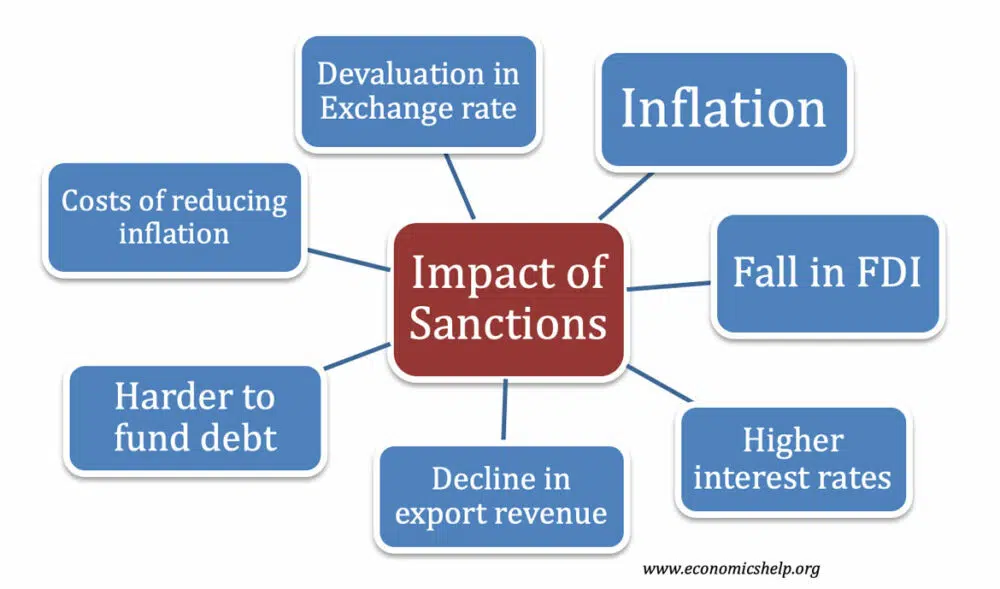
It’s a foregone conclusion that sanctions negatively affects the social sector of the recipient country and ultimately the standard of living. sanctions are a tool covertly and overtly targeting the weakest in society for political ends. Import restrictions disrupts the supply chains for basic goods, including healthcare, education, and quality of life. On the other hand, the Universal Declaration of Human Rights declares that everyone has the right to a standard of living adequate for their health and well-being, including food and medical care, housing, and the necessary social services. The lack of investment and support in agriculture for a country that has 60% of its population living off agriculture meant that most of the people got pushed into food insecurity, malnutrition, and poverty. At 23% food inflation in real terms, Zimbabwe  has the second worst food price increase. only second to Lebanon. This translates into shortages in domestic food supply and declining agricultural production. This is compounded by a lack of foreign currency to import food.

Sanctions are a Violation of Human Rights

Sanctions violates Universal Declaration of Human Rights inherent the dignity and of the equal and inalienable rights. There is discouraging data about their grim impact on the rights and well-being of ordinary and otherwise innocent citizens. If the goal is to improve the lives of the people of a country, systematically impoverishing them is a strange way to go about it. The Office of the United Nations High Commissioner for Human Rights (OHCHR) called the sanctions ‘brutal and ineffective tool that disproportionately harms the very same people they are enforced to protect’. They went on to say ‘unilateral coercive measures are contrary to the United Nations Charter, International Law, International Humanitarian Law, and the norms and principles governing peaceful relations among States’. Need I say more?

Sanctions are borderline Unethical

While in war there is direct and relatively quick killing, economic sanctions are a slow and painful killer. Imagine dying of hunger which can happen over a period of 60 days or 8 to 21 days if one has no access to drinking water. Slow and painful indeed. Sanctions are thus unethical. More so that they effectively pauperize the most vulnerable (women, children, the sick, the aged etc) and leave political elites barely touched. Using poverty as a tool for politics is morally wrong. The collateral damage caused is unjustified not only to Zimbabweans but also to neighboring countries where some Zimbabweans have gone for better opportunities. Others link the rise in xenophobia in South Africa, with foreign nationals like Zimbabweans coming under violent attack, to the effects of sanctions. Butterfly effect? 

Conclusion

The question of the effectiveness of economic sanctions has already been addressed by Hufbauer et al. Even when it was never answered, what is the agreed measure of success? Change of regime or changes in the behavior of a regime. Like I have repeatedly explained, economic sanctions do not affect those in power, those who make decisions which attracts external anger. No. Sanctions affect and impoverishes the common man. The very same man these sanctions are meant to protect. What is a more travesty is that sanctions just entrenched the political life of the elites. If there is a lesson from all this is that we cannot be talking about improving human rights by depriving people of basic tools to their "Life, Liberty and the pursuit of Happiness". Sanctions serve little in effecting their objectives. Thus, they just become symbolic, an academical exercise, meant to show who’s boss in global politics. Or maybe, they are justifiable? What do you think, dear reader?