Showing posts with label Ethics. Show all posts

Tuesday, August 12, 2025

Reimagining Zambia's Politics

With exactly 12 months until Zambia’s 2026 general elections, tribal politics remains a persistent force shaping the country’s democratic landscape. Despite the nation’s rich diversity of over 73 languages and ethnic groups, which should be a source of strength, political strategies that exploit ethnic identities for power have instead fostered division. Far from empowering marginalized communities, tribal politics promotes exclusion, entitlement and inefficiency. It has made people identify with their groups so strongly that they'll believe untruths — even far-fetched conspiracy theories — over any reality that conflicts with the values of their tribe. This essay argues that tribal politics must be eradicated through a commitment to unity, merit-based public office appointments and objective policy discussions. Reimagining politics in Zambia requires transcending tribal divisions to build a system where competence and shared national goals prevail over ethnic loyalties. 

Tribal politics in Zambia is driven by a complex interplay of economic, psychological, institutional and historical factors.

First, economic competition often fuels ethnic mobilization. In a resource-scarce environment like ours, different groups jostling for jobs, land and infrastructure often align along tribal lines. Recent social media posts, for example, highlight grievances from rural provinces that perceive neglect compared to urban centers like Lusaka. These disparities must be addressed through equitable, merit-based resource allocation, not through tribal favoritism. 

Second, psychological fears of domination by other ethnic groups amplify tribal identities. Scholars note that perceived threats to cultural or political influence drive groups to support tribal leaders. This dynamic has been evident in almost every general election in Zambia, where political campaigns have stoked fears of one tribe’s dominance. These divisive appeals must be replaced with objective discussions focused on national progress. Such rhetoric remains a default vote-hunting strategy for many politicians, undermining national unity

Third, weak institutions perpetuate tribalism by failing to ensure equitable resource distribution or address psychological needs for recognition. Zambia’s centralized governance system fuels perceptions of ethnic favoritism, as seen in accusations leveled against nearly all cabinet appointments. Moreover, some churches exacerbate this issue by aligning with politicians who promote tribal sentiments, undermining their role as neutral arbiters. The Penal Code’s Section 70(1), strengthened by the 2024 amendment bill, is a step toward curbing tribal hate speech and fostering institutional trust. However, its enforcement must carefully avoid stifling free speech to maintain institutional credibility.

Finally, Zambia’s colonial legacy entrenched ethnic divisions. Before colonialism, Zambian tribes lived in distinct areas with unique languages, customs, and myths. When the British arrived, their divide-and-rule tactics magnified differences, instigating conflicts over resources like water and pasture. These colonial policies sowed distrust among tribes, creating negative stereotypes that persist today. In modern Zambia, some educated elites weaponize tribalism, linking it to social status and determining access to opportunities.

In the present, tribalism has been weaponized by some members of the educated elite, linking it to social status and using it to determine people’s fortunes. Intellectuals on both sides of the political divide justify “ethnicity” as central to traditional culture and seek the framing of the party and state around it. Even more troubling is the role of some churches, which have aligned with politicians promoting tribal sentiments. As the 2026 general elections approach, it is common to see politicians seeking a pulpit to “greet the congregation,” a practice that undermines the church's role as a unifying force. This complicity erodes public trust in both religious and political institutions. The church is no longer trusted to be a neutral arbiter.

Eradicating tribal politics is essential for Zambia’s progress. A unified approach to resource allocation and leadership selection is critical. Transparent systems prioritizing need over tribe can dismantle ethnic patronage. For instance, infrastructure projects should target underdeveloped regions based on economic data, not political loyalty. Responsible enforcement of Section 70(1) can deter hate speech while preserving free expression. Media houses must foster objective discussions on priorities like education and infrastructure, rather than amplifying tribal grievances. The church, reclaiming its role as a moral authority, should reject tribal rhetoric and advocate for inclusive leadership.

Ultimately, appointments and jobs must prioritize qualifications and competence over tribal origin. Expecting every tribe to have a government seat is both divisive and inefficient. Instead, Zambia must build a system where talent and ideas prevail, transforming its diversity from a source of conflict into a wellspring of national strength. However, the political elite lack incentive for reform, as tribalism secures their power, leaving citizens to demand accountability.

In conclusion, tribalism in Zambia hinders democracy and socio-economic development. It persists as a channel for resources and benefits. to flow from those in power to their tribesmen, prioritizing tribal loyalty over national interest. Tribalism fuels underdevelopment, corruption, election rigging and violence. It undermines meritocracy, with unqualified individuals securing jobs based on tribe, leading to inefficient resource use. Natural resources in some regions are ignored or underutilized due to tribal biases. Bad governance thrives as tribes support their leaders blindly, while opposing tribes criticize even effective governments. Zambia’s path forward lies in fostering unity, enforcing equitable policies and prioritizing competence to harness its diversity for progress. Reimagining politics demands a collective commitment to a future where Zambia’s diversity fuels inclusive governance, not division.
Sunday, October 2, 2022

AFTER TWO DECADES OF ECONOMIC SANCTIONS ON ZIMBABWE, ARE THEY JUSTIFIABLE?

Zimbabwe is 42 years old and almost half of that has been lived under economic sanctions. It was refreshing, thus, when African leaders used the United Nations General Assembly (UNGA) some few days ago to push for an end to more than 20-year western sanctions on Zimbabwe, arguing that the sanctions are damaging to ordinary people and the region. Senegalese President Macky Sall, the head of the African Union (AU), called for the "immediate lifting of sanctions to allow Zimbabwe to realize its full potential". The President of the Democratic Republic of the Congo, Felix Tshisekedi, who’s also the current leader of the Southern African Development Community (SADC), described the sanctions against Zimbabwe as "a crime against an innocent people.'

According to Kenyan President William Ruto, "the one-sided coercive measures such as those imposed on Zimbabwe not only punish the sovereign equality of nations, but also indiscriminately punish the general citizenry and retain their bitterest sting for innocent hustlers and the weak." South Africa's President Cyril Ramaphosa demanded (speaking through Foreign Minister Naledi Pandor) "an end to unilateral coercive measures against Zimbabwe which have exacerbated the problems of the Zimbabwean people". Ramaphosa would also in a meeting with US President Joe Biden ask for the lifting of sanctions in Zimbabwe.

These African leaders are on terra firma and I elect to stand with them. A father that stops buying food because he has a bone to chew with his wife isn’t punishing the wife, but mainly the children. Besides chewing bones can be dangerous, no matter what size or what type. Like the famous African proverb, "when elephants fight, it’s the grass that suffers". A miscalculation in the game theory and underplaying the butterfly effect.

Background

After the signing of the Lancaster House Agreement on 21 December 1979, brining to an end of the Second Chimurenga also called the Zimbabwe War of Independence and to the internationally recognition of Zimbabwe from Rhodesia. This also meant the full resumption of direct British rule and the reversal of the 1965 Unilateral Declaration of Independence (UDI). Independence would be granted on 18 April 1980 with Robert Mugabe becoming the first indigenous Prime Minister.

In the very same 1980, the infamous – or famous depending on which side of the fence you are on – Land Reforms would start with partial funding from the United Kingdom which saw the resettling of around 70,000 black people initially without land on 4,900,000 acres in the new independent Zimbabwe. This was a drop in the proverbial ocean. The US and UK had offered to compensate white citizens for any land sold to aid reconciliation using the "Willing buyer, Willing seller" principle which is a market driven land reform with much support from landowners. However, this failed to right the wrongs made by the historical expropriation and high poverty. In the late 1990s, the then President Robert Mugabe declared the compulsory acquisition of land. Land acquisitions would turn violent in the early 2000s with 7 white farmers being killed and “much larger number of black victims” working on those farmers. This was the watershed moment.

The Zimbabwean economy would suffer a great hit which people like Craig J. Richardson attributing it to the land reforms. The EU, UK, Canada, Australia, New Zealand and the US would also place sanctions on Zimbabwe because of ‘the land reforms and the human rights abuses’. Its more than 2 decades now and the leadership in Harare has changed but nothing much has changed on the sanctions despite the standing ovations given to the ousting of Mugabe as president.

Now, dear reader, I’m not Zimbabwean. I have never been to Zimbabwe. I’m not a historian. I'm just a keen student of life and life has many lessons for all of us. I’m just here to critique sanctions as a human rights abuse. I will highlight why I feel that they create the very problem that it envisages to solved. As you read, dear reader, you must also not forget that the objective of the Chimurenga fighters was to reclaim their lands by challenging the IDU and colonialism while also achieving democratic autonomy.

Do Sanctions Work?

States, its agencies and agents including independent great minds have always claimed that the most effective way of bringing a wayward country back into line is by placing economic sanctions on it. The war without guns. Economic sanctions are coordinated restrictions on trade and financial transactions intended to impair economic life within a given territory. Since the end of the cold war, they have been more prevalent.

However, the ethical, political and moral justifications for such measures are seldom interrogated. In Economic Sanctions Reconsidered, Gary Clyde Hufbauer, Jeffrey J. Schott, Kimberly Ann Elliott and Barbara Oegg of Peterson Institute for International Economics (PIIE) studied more than 200 economic sanction cases and concluded that only succeeded in 1/3 of all cases. In 2/3 of application, the sanctions had failed to achieve the intended objective. Below I explain the consequences on sanctions on healthcare, education, human rights, and ethics on the recipient country. What history will be written as an outcome of these sanction?

Sanctions Negatively Affects the Healthcare System

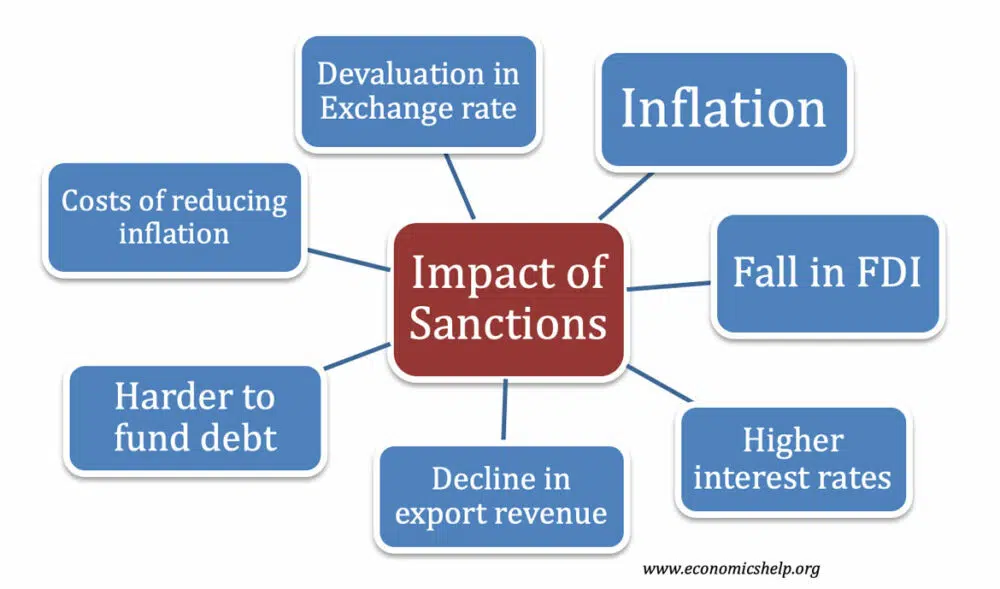
Sanctions may not formally ban the exports of medicines; in practice, however, patients are experiencing great difficulty in securing the treatment. This significantly cripple the public healthcare system. And this negates all the progress that had been made in improving quality, leading to a huge economic and social costs which may include disability and lost productivity, and generally low quality of life in the population. All the progress 1980s was severely disrupted and saw the period from the 2000s resulted in a sharp and prolonged decline in health expenditure and increasing health inequalities. For example, neonatal complications, protein energy malnutrition and lower respiratory infections caused 24.64%, 1.85% and 10.27%, respectively, of under 5 deaths in 1999 before sanctions kicked in. 20 years later in 2019, there was an increase to 36.52%, 6.77% and 19.48% in deaths caused by neonatal complications, protein energy malnutrition and lower respiratory infections respectively. Public healthcare across the country is currently grappling with a growing shortage of nurses driven by the search for private jobs and greener pasture, particularly in the UK.

However, when those in leadership get sick, they are flown out to South Africa, India or China to access proper and quality healthcare since the healthcare system back home is dead. They live and die in opulence. And so, do their children and close relations. A travesty.

Sanctions Negatively Affects Education

Because of the country’s failure to trade and access certain resources, schools would lack facilities like electricity, libraries, computers, textbooks, and a good transport network. This is in addition to lack of resources to recruit more teachers and pay the already recruited ones. Inevitably this result in the collapse of the education system. As in every other sector, teachers are leaving the country in search of better opportunities and this brain drain leaves a huge teacher-student ratio. Monica Zembere claimed that between 2000 and 2010, around 80% of secondary schools in Mbire District in Mashonaland Central were staffed by either untrained teachers or primary trained teachers.  Also, many Zimbabweans who emigrate to study do not return to their home country immediately after completing their studies due to better opportunities there. it cannot be overemphasized enough how an educated population is essential to a nation’s prosperity and health democracy.

The elites who are meant to be targeted by the sanctions, however, send their children get an education from abroad. 

Sanctions and the Living Standards

It’s a foregone conclusion that sanctions negatively affects the social sector of the recipient country and ultimately the standard of living. sanctions are a tool covertly and overtly targeting the weakest in society for political ends. Import restrictions disrupts the supply chains for basic goods, including healthcare, education, and quality of life. On the other hand, the Universal Declaration of Human Rights declares that everyone has the right to a standard of living adequate for their health and well-being, including food and medical care, housing, and the necessary social services. The lack of investment and support in agriculture for a country that has 60% of its population living off agriculture meant that most of the people got pushed into food insecurity, malnutrition, and poverty. At 23% food inflation in real terms, Zimbabwe  has the second worst food price increase. only second to Lebanon. This translates into shortages in domestic food supply and declining agricultural production. This is compounded by a lack of foreign currency to import food.

Sanctions are a Violation of Human Rights

Sanctions violates Universal Declaration of Human Rights inherent the dignity and of the equal and inalienable rights. There is discouraging data about their grim impact on the rights and well-being of ordinary and otherwise innocent citizens. If the goal is to improve the lives of the people of a country, systematically impoverishing them is a strange way to go about it. The Office of the United Nations High Commissioner for Human Rights (OHCHR) called the sanctions ‘brutal and ineffective tool that disproportionately harms the very same people they are enforced to protect’. They went on to say ‘unilateral coercive measures are contrary to the United Nations Charter, International Law, International Humanitarian Law, and the norms and principles governing peaceful relations among States’. Need I say more?

Sanctions are borderline Unethical

While in war there is direct and relatively quick killing, economic sanctions are a slow and painful killer. Imagine dying of hunger which can happen over a period of 60 days or 8 to 21 days if one has no access to drinking water. Slow and painful indeed. Sanctions are thus unethical. More so that they effectively pauperize the most vulnerable (women, children, the sick, the aged etc) and leave political elites barely touched. Using poverty as a tool for politics is morally wrong. The collateral damage caused is unjustified not only to Zimbabweans but also to neighboring countries where some Zimbabweans have gone for better opportunities. Others link the rise in xenophobia in South Africa, with foreign nationals like Zimbabweans coming under violent attack, to the effects of sanctions. Butterfly effect? 

Conclusion

The question of the effectiveness of economic sanctions has already been addressed by Hufbauer et al. Even when it was never answered, what is the agreed measure of success? Change of regime or changes in the behavior of a regime. Like I have repeatedly explained, economic sanctions do not affect those in power, those who make decisions which attracts external anger. No. Sanctions affect and impoverishes the common man. The very same man these sanctions are meant to protect. What is a more travesty is that sanctions just entrenched the political life of the elites. If there is a lesson from all this is that we cannot be talking about improving human rights by depriving people of basic tools to their "Life, Liberty and the pursuit of Happiness". Sanctions serve little in effecting their objectives. Thus, they just become symbolic, an academical exercise, meant to show who’s boss in global politics. Or maybe, they are justifiable? What do you think, dear reader?